Happy new year to everyone reading this, and thank you for sticking with Service Break into another season of sport, stories and probably too many late‑night score checks. On a personal note, this is the first piece written post‑dissertation hand‑in, which means the caffeine can finally be for volleyball and kit launches rather than citation formatting.
The 1 Point Slam: Tennis as a jump scare
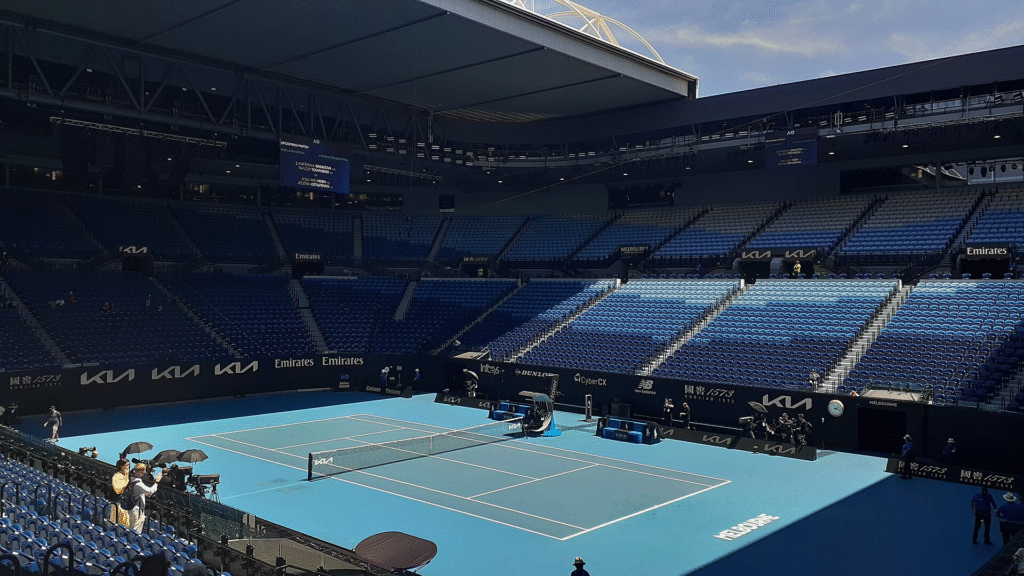
Four days before the Australian Open, Melbourne Park hosted the Million Dollar 1 Point Slam, a knockout exhibition where amateurs, pros and a few TV faces played matches decided by a single point for a total prize pool of A$1 million.[olympics]
- Format in plain terms
- One point per “match”. Win and you move on, lose and you are out.
- Pros got one serve, amateurs without an ATP/WTA ranking got two.
- Rock, paper, scissors decided who served.
- Who turned up
- Carlos Alcaraz, Jannik Sinner, Daniil Medvedev, Alexander Zverev, Frances Tiafoe.
- Iga Swiatek, Coco Gauff, Amanda Anisimova, Elena Rybakina.
- Local qualifiers and invited amateurs from the Australian pathway.
The script said a Grand Slam champion would collect an easy cheque. Instead, 29‑year‑old Sydney coach and state champion Jordan Smith beat five pros in a row, including defending Australian Open champion Sinner, to win the top prize. Sinner’s only serve in their point clipped the net, proving that even the world number two is one bad toss away from turning a year of training into someone else’s side hustle.
On the other side of the draw, world number 117 Joanna Garland took out Nick Kyrgios, Alexander Zverev and Donna Vekic to reach the final, before missing a forehand that handed Smith the title. The whole thing was clipped and pushed to TikTok and Instagram within hours, which was exactly the intention: a full Rod Laver Arena and a global highlight reel before the main draw even started.
For players, it was a marketing exercise disguised as a panic attack. For students, it looked suspiciously like an exam worth 100 percent of your grade where the entire paper is one multiple‑choice question.
Less football, more everything else
Away from Melbourne, January has been busy across sports that actually coexist with seminar timetables:
- Darts
Luke Littler, still only 18, opened the year by retaining his PDC World Darts Championship title 7–1 over Gian van Veen at Ally Pally, averaging 106.02 and earning the event’s new £1 million top prize. Darts continues to prove that if you package a niche sport with atmosphere and storylines, students will absolutely tune in between lectures. - Winter sport
The Milano Cortina 2026 Winter Olympics start in early February, with events spread across Milan, Cortina d’Ampezzo and three other Italian regions. Britain’s Matt Weston has just secured his third straight overall skeleton World Cup title, finishing on 1,545 points and giving UK Sport a clear medal focal point on ice. - United Cup
In Sydney, Poland finally won the United Cup mixed team event, beating Switzerland in the final after Hubert Hurkacz levelled the tie and the mixed doubles team closed it out. Great Britain exited earlier in a 2–1 loss to Greece, with Stefanos Tsitsipas turning their tie around in the deciding match.
Football is still doing its January transfer‑window thing in the background, but for once it is not the only sport dictating the group chat.
Kits and creatives setting up the year
For anyone thinking about sport as a workplace rather than just a pastime, the early creative moves in 2026 matter.
- World Cup kits
Adidas have already revealed all 22 federation home shirts for the 2026 World Cup, leaning into heritage for Argentina and Germany and standardising performance with their CLIMACOOL+ tech across all designs. Nike’s kits for 30 national teams are still in leak mode, with online reaction already influencing tweaks to some of the bolder concepts before official launch. - Smaller clubs, bigger ideas
Worcestershire CCC flew senior players to Bologna to launch their 2026 kit at Macron’s headquarters, aiming to position county cricket closer to fashion editorial than village‑green stereotype. In Florida, the Orlando Pirates have opened their 2026 alternate jersey to local artists, running a design competition that turns a kit into a community brief and a portfolio piece.
If you are a student creator, these are the kinds of projects to watch. They tell you what brands and clubs will pay for in 2026: shirts that carry culture, campaigns that live on social first, formats like the 1 Point Slam that are basically content engines built into match schedules.
Why this start to the year matters
The opening weeks of 2026 are already showing a pattern:
- Federations are willing to experiment in public if it wins attention, whether that is a million‑dollar single point in tennis or flying a county cricket team to Italy for a launch shoot.
- Creatives are moving closer to the centre of sport, from kit designers and video teams to local artists trusted with reimagining a club’s identity.
- Pathways are messy but real. Jordan Smith went from coaching in Sydney to winning A$1m on a one‑point exhibition night. Luke Littler turned a youth‑league origin story into back‑to‑back world titles before most people finish their first degree.
For Service Break and for anyone reading this in a library break, the message is simple enough. Stay close to the edges of sport, where new formats, new kits and new roles are being tested. That is where the work will be, long after the 1 Point Slam clips have disappeared into the algorithm.