
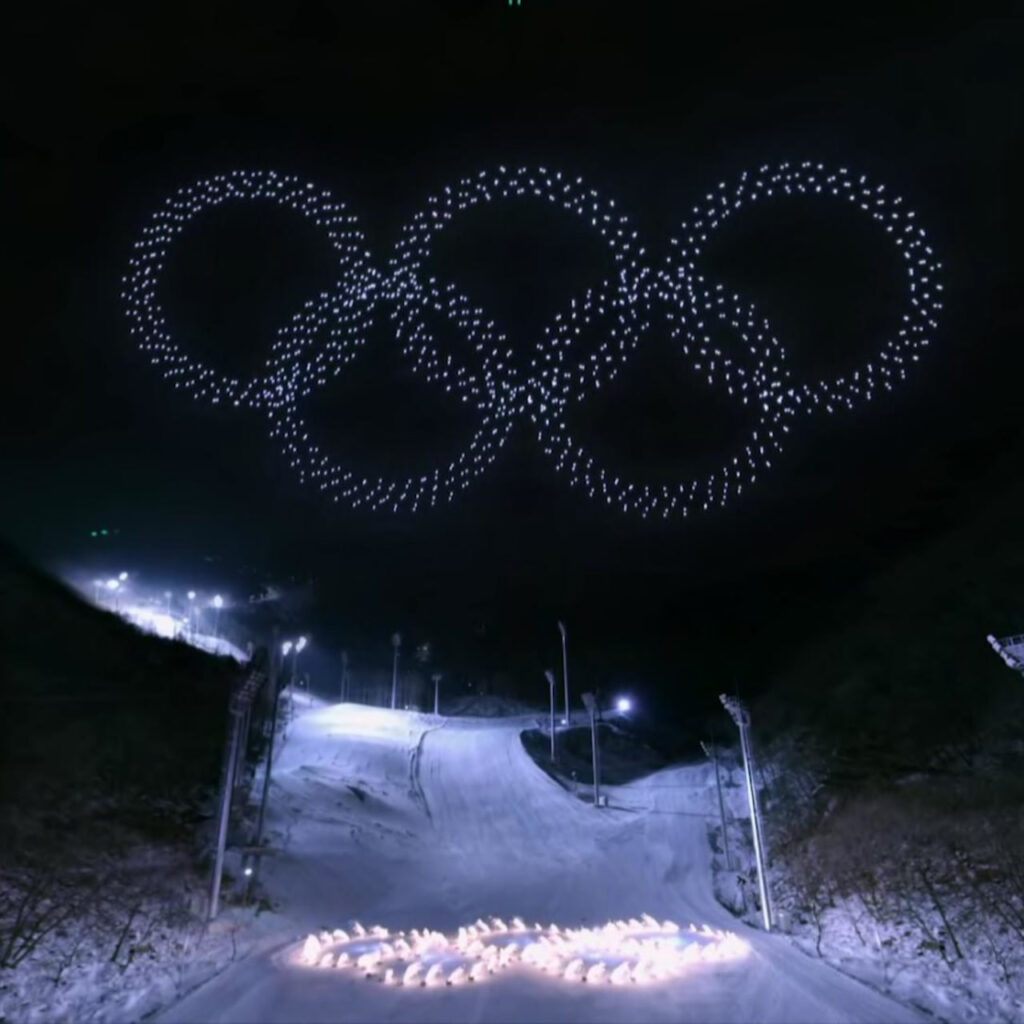
The faint whirring you’ve heard under the commentary and cowbells during downhill, luge or speed skating at Milano–Cortina 2026 is not your TV dying. It is a fleet of first-person view drones, now embedded into the Olympic broadcast in a way we have never seen before. For better and worse, the Games have entered their drone era.
What are these drones actually doing?
Olympic Broadcasting Services (OBS) is running what is likely the largest drone operation ever at a single sporting event: around 25 FPV (first-person view) drones as part of a wider arsenal of more than 800 camera systems and 1,800 microphones covering the Winter Games. FPV drones are piloted through goggles that show a live feed from the drone’s camera, which lets operators fly extremely close to the action and pull off aggressive lines that would be impossible with helicopters or cable cams.
In Milano–Cortina, those drones are chasing skiers at up to 120 km/h down the downhill course, tracking luge and skeleton sleds along the ice canal, and even shadowing speed skaters and snowboarders along their lines. The idea, according to OBS chief executive Yiannis Exarchos, is to add a “true third dimension” to coverage, moving beyond fixed cameras and cable cams to something that can dive, roll and accelerate with the athletes rather than just watch them.
Behind that aerial ballet sits a global broadcast machine. OBS has around 5,000 staff and freelancers from more than 100 countries in Italy, delivering more than 6,500 hours of content, including 900+ hours of live competition. They partner with specialist FPV outfits like Dutch Drone Gods, whose custom-built rigs, HD links and integration work have already been tested at events such as UCI mountain bike World Cups and are now tuned for Olympic slopes and tracks.
Why broadcasters love them
From a storytelling perspective, the drones are a breakthrough. They can:
- Follow an athlete for an entire run from only a few metres behind, giving viewers a visceral sense of speed and line choice that traditional tower or helicopter shots simply cannot match.
- Fly at eye level or just above the snow or ice, revealing how close skis, boards or blades run to the edge of control, and how quickly decisions are made at Olympic pace.
- Move freely around features in freestyle parks or over jumps in ski jumping and big air, delivering angles that used to be the preserve of video games or CGI.
Organisers argue that drones make coverage more immersive without affecting performances. The IOC and OBS both insist that flight paths are tightly mapped, no-fly zones are baked in, and pilots rehearse lines repeatedly to avoid distracting or endangering competitors. In practice, the drones often run behind or slightly offset from the athlete, outside their direct field of view, while still close enough to produce dramatic images.
For younger viewers raised on GoPro POVs, gaming cameras and creator content, the FPV aesthetic feels familiar and instinctively engaging. Clips from downhill, big air and luge have already dominated social feeds precisely because they look like something from a racing game, not a static TV truck.
The growing backlash over the buzz
The flip side is that these drones are not subtle. FPV rigs use powerful motors and spinning props that generate a distinctive, high-pitched whine, especially when they are pushing hard to keep up with athletes. That whir is now bleeding into TV mixes and causing a split in opinion.
Broadcasters and tech press have praised the visuals but admitted the sound is grating. TechRadar described viewers complaining that the drones’ buzzing can drown out “the sounds of metal, fiberglass and wood on ice (and cowbell)”, which are part of the winter sport atmosphere. On BBC Sport, analysis pieces around skiing and luge have described the footage as “dramatic but divisive,” pointing to mixed reactions from audiences who love the shots but resent the audible drone presence. Reddit threads in both broadcast engineering and Winter Olympics subcommunities feature people calling the sound “irritating” and wondering why more aggressive filtering or noise reduction is not deployed in the world feed.
Organisers are downplaying those concerns. IOC sports director Pierre Ducrey has framed the drones as an evolution rather than an intrusion, arguing that they enrich the viewer experience and are kept from impacting athletes, with sound treated as a production problem rather than a sporting one. Engineers point out that some buzz inevitably spills into crowd and atmosphere mics, especially in mountain venues where sound bounces around, and that removing it entirely without deadening all ambient sound is non-trivial.
There is also a philosophical question for fans: winter sports have a particular soundscape, from the carve of edges on hard snow to the rattle of skeleton runners on ice. If the dominant audio cue becomes an electric whine, some feel that you are watching a tech demo, not alpine skiing.
Safety, regulation and the invisible infrastructure
The fact that drones are flying so close to Olympic athletes is possible only because the regulatory and technical groundwork has changed. For Milano–Cortina, Italy’s Ministry of Enterprises and Made in Italy authorised around 8,000 radio frequencies specifically for immersive technologies, covering everything from FPV links to timing, comms and body-cams. That spectrum management is what stops drone control signals from interfering with critical systems or each other and lets multiple aircraft fly in complex environments without crosstalk.
On the safety side, the drones used for live broadcast at the Games are not hobby toys. They are purpose-built FPV platforms with:
- Redundant control links and high-reliability video transmitters designed for broadcast integration.
- Strict geofencing and pre-programmed corridors that limit where they can go relative to crowds, athletes and infrastructure.
- Dedicated pilots and spotters working to broadcast director cues, often after weeks of on-site training and line rehearsal.
OBS and partners like Dutch Drone Gods have already accumulated experience at major events, and for Milano–Cortina those teams are folded into the same operational frameworks that manage helicopter, cablecam and railcam deployments. As Exarchos put it in the build-up to the Games, “a new generation of technology” now allows safe drone use “very close to the action,” something that simply wasn’t feasible with earlier generations of gear and regulation.
The people and companies behind the shots
At the organisational level, the key name is Olympic Broadcasting Services, the IOC-controlled company that produces the world feed. OBS is responsible for choosing where drones are used, how they are mixed with traditional shots, and how much experimental tech makes it onto the main broadcast versus supplementary feeds.
On the technical side, FPV drone specialists such as Dutch Drone Gods provide much of the hardware, piloting and broadcast integration. Their rigs are designed to carry professional cine cameras and broadcast transmitters while still flying like racing drones, and they have been working with partners like Broadcast Rental and Theis Media to plug those drones into existing camera and routing infrastructures. Other providers contribute body-cam systems, 5G-enabled mobile cameras and AI-driven replay tools, all of which sit alongside the drones in OBS’s bid to make Milano–Cortina its “most immersive and data-rich” Winter Games coverage yet.
Then there are the less visible engineers: RF planners who carve up those 8,000 frequencies; safety officers who sign off on flight plans; sound mixers trying to keep some of the drone buzz while preserving the character of each sport; and directors making real-time decisions about when a dramatic FPV chase is worth the trade-off in noise.
Where this leaves the future of Olympic coverage
For now, drones at Milano–Cortina are both a clear success and a live experiment. They have given fans unprecedented views of downhill gates, big air kickers and luge lines, and they have proven that FPV can be integrated at scale into a major multi-sport event without disrupting competition. They have also triggered a genuine debate about what we want Olympic sport to sound and feel like on screen, and how much visible technology is too much.
Exarchos and OBS are already hinting that what we see in 2026 is just the start, with AI-enhanced replays, drone fleets and immersive camera rigs increasingly woven together into a single storytelling fabric. The whirring that viewers hear under the commentary today may be refined, filtered or partially tamed in future editions, but it is unlikely to disappear. The third dimension has arrived, and the Olympics are not going back to two.